
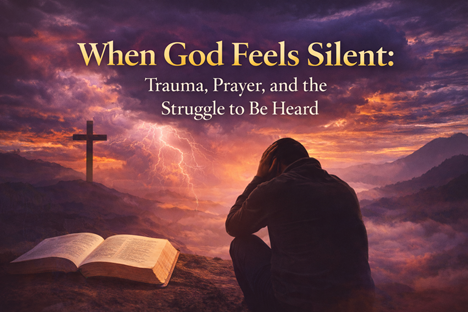
There are moments in life when prayer stops feeling like connection and starts feeling like silence.
Words go up—but nothing seems to come back.
And for those who have experienced trauma, that silence can feel louder than anything else.
Not peaceful silence.
Not reverent silence.
But a silence that feels like absence.
The kind that makes a person ask:
“Is God listening?”
“Does He care?”
“Or am I speaking into nothing?”
These questions are not signs of weak faith.
They are often the echoes of unresolved pain.
Silence Feels Different When You’ve Been Wounded
For someone without deep emotional wounds, silence may feel like waiting.
But for someone who has experienced trauma, silence can feel like:
abandonment
neglect
rejection
Because trauma teaches you something dangerous:
“When no one responds, you are on your own.”
So when prayer feels unanswered, it doesn’t just feel spiritual—it feels personal.
A delayed answer can feel like denial.
A quiet season can feel like distance.
A waiting period can feel like being ignored.
But the question must be asked carefully:
Is God silent… or is trauma interpreting the silence?
Biblical Reality: Silence Is Not Absence
Bible does not present a God who is always verbally responsive—but it does present a God who is always present.
Consider Job.
He cried.
He questioned.
He demanded answers.
And for a long stretch, heaven did not respond the way he expected.
But silence did not mean absence.
God was present in every moment Job endured.
Consider David:
“How long, Lord? Will you forget me forever?” (Psalm 13:1)
David felt forgotten—but he was not forgotten.
Consider Jesus Himself.
On the cross, He cried:
“My God, My God, why have You forsaken Me?”
That is not a casual statement.
That is the language of perceived abandonment.
And yet—even there—God had not abandoned Him.
Trauma and the Misinterpretation of Silence
Trauma trains the mind to fill in gaps with fear.
So when God does not respond immediately, trauma begins to interpret:
“He does not care”
“He is not listening”
“I am not important enough”
“This will never change”
But silence is not always rejection.
Sometimes silence is:
formation
protection
timing
preparation
And sometimes, silence is simply:
God working in ways that are not immediately visible.
Why Prayer Becomes Difficult After Trauma
Prayer requires vulnerability.
But trauma teaches self-protection.
So now there is tension:
You want to pray…
but you don’t feel safe opening up.
Some people stop praying altogether.
Others pray, but with distance.
Others speak words, but feel nothing.
And some are afraid to be honest with God because they think honesty is disrespect.
But let this be made clear:
God is not threatened by your honesty.
The Psalms are filled with raw emotion—anger, confusion, grief, frustration.
God did not silence those prayers.
He preserved them.
How to Pray When God Feels Silent
Start where you are—not where you think you should be.
If all you have is:
“I don’t understand”
“I feel alone”
“This hurts”
Then start there.
That is still prayer.
You do not need perfect language.
You need honest presence.
1. Pray honestly, not performatively
God already knows what you feel.
You are not informing Him—you are opening to Him.
2. Separate feeling from truth
You may feel abandoned.
That does not mean you are abandoned.
Feelings are real—but they are not always reliable.
3. Stay consistent, even when it feels dry
Consistency builds connection, even when emotion is absent.
4. Use Scripture when words fail
Let God’s Word speak when you cannot.
5. Allow silence without defining it
Not every quiet moment is rejection.
Compassion with Clarity
Let this be said carefully:
Your pain is real.
Your struggle is valid.
Your questions matter.
But trauma does not get to define God’s character.
Silence is not proof of abandonment.
Delay is not proof of neglect.
God is still present—even when He is not loud.
Final Encouragement
If God feels silent to you, do not walk away.
Lean in—even if it feels uncomfortable.
Because sometimes the deepest work God does
is not in what He says…
but in what He is forming.
You are not unheard.
You are not unseen.
And you are not alone.
Even here—He is present.